 Add to Chrome
 Add to Firefox
 Add to Edge
Liver Segmentation
Papers and Code
VasGuideNet: Vascular Topology-Guided Couinaud Liver Segmentation with Structural Contrastive Loss
Feb 25, 2026
Accurate Couinaud liver segmentation is critical for preoperative surgical planning and tumor localization.However, existing methods primarily rely on image intensity and spatial location cues, without explicitly modeling vascular topology. As a result, they often produce indistinct boundaries near vessels and show limited generalization under anatomical variability.We propose VasGuideNet, the first Couinaud segmentation framework explicitly guided by vascular topology. Specifically, skeletonized vessels, Euclidean distance transform (EDT)--derived geometry, and k-nearest neighbor (kNN) connectivity are encoded into topology features using Graph Convolutional Networks (GCNs). These features are then injected into a 3D encoder--decoder backbone via a cross-attention fusion module. To further improve inter-class separability and anatomical consistency, we introduce a Structural Contrastive Loss (SCL) with a global memory bank.On Task08_HepaticVessel and our private LASSD dataset, VasGuideNet achieves Dice scores of 83.68% and 76.65% with RVDs of 1.68 and 7.08, respectively. It consistently outperforms representative baselines including UNETR, Swin UNETR, and G-UNETR++, delivering higher Dice/mIoU and lower RVD across datasets, demonstrating its effectiveness for anatomically consistent segmentation. Code is available at https://github.com/Qacket/VasGuideNet.git.

Semi-supervised Liver Segmentation and Patch-based Fibrosis Staging with Registration-aided Multi-parametric MRI
Feb 10, 2026Liver fibrosis poses a substantial challenge in clinical practice, emphasizing the necessity for precise liver segmentation and accurate disease staging. Based on the CARE Liver 2025 Track 4 Challenge, this study introduces a multi-task deep learning framework developed for liver segmentation (LiSeg) and liver fibrosis staging (LiFS) using multiparametric MRI. The LiSeg phase addresses the challenge of limited annotated images and the complexities of multi-parametric MRI data by employing a semi-supervised learning model that integrates image segmentation and registration. By leveraging both labeled and unlabeled data, the model overcomes the difficulties introduced by domain shifts and variations across modalities. In the LiFS phase, we employed a patchbased method which allows the visualization of liver fibrosis stages based on the classification outputs. Our approach effectively handles multimodality imaging data, limited labels, and domain shifts. The proposed method has been tested by the challenge organizer on an independent test set that includes in-distribution (ID) and out-of-distribution (OOD) cases using three-channel MRIs (T1, T2, DWI) and seven-channel MRIs (T1, T2, DWI, GED1-GED4). The code is freely available. Github link: https://github.com/mileywang3061/Care-Liver
OmniCT: Towards a Unified Slice-Volume LVLM for Comprehensive CT Analysis
Feb 18, 2026Computed Tomography (CT) is one of the most widely used and diagnostically information-dense imaging modalities, covering critical organs such as the heart, lungs, liver, and colon. Clinical interpretation relies on both slice-driven local features (e.g., sub-centimeter nodules, lesion boundaries) and volume-driven spatial representations (e.g., tumor infiltration, inter-organ anatomical relations). However, existing Large Vision-Language Models (LVLMs) remain fragmented in CT slice versus volumetric understanding: slice-driven LVLMs show strong generalization but lack cross-slice spatial consistency, while volume-driven LVLMs explicitly capture volumetric semantics but suffer from coarse granularity and poor compatibility with slice inputs. The absence of a unified modeling paradigm constitutes a major bottleneck for the clinical translation of medical LVLMs. We present OmniCT, a powerful unified slice-volume LVLM for CT scenarios, which makes three contributions: (i) Spatial Consistency Enhancement (SCE): volumetric slice composition combined with tri-axial positional embedding that introduces volumetric consistency, and an MoE hybrid projection enables efficient slice-volume adaptation; (ii) Organ-level Semantic Enhancement (OSE): segmentation and ROI localization explicitly align anatomical regions, emphasizing lesion- and organ-level semantics; (iii) MedEval-CT: the largest slice-volume CT dataset and hybrid benchmark integrates comprehensive metrics for unified evaluation. OmniCT consistently outperforms existing methods with a substantial margin across diverse clinical tasks and satisfies both micro-level detail sensitivity and macro-level spatial reasoning. More importantly, it establishes a new paradigm for cross-modal medical imaging understanding.
3DLAND: 3D Lesion Abdominal Anomaly Localization Dataset
Feb 13, 2026Existing medical imaging datasets for abdominal CT often lack three-dimensional annotations, multi-organ coverage, or precise lesion-to-organ associations, hindering robust representation learning and clinical applications. To address this gap, we introduce 3DLAND, a large-scale benchmark dataset comprising over 6,000 contrast-enhanced CT volumes with over 20,000 high-fidelity 3D lesion annotations linked to seven abdominal organs: liver, kidneys, pancreas, spleen, stomach, and gallbladder. Our streamlined three-phase pipeline integrates automated spatial reasoning, prompt-optimized 2D segmentation, and memory-guided 3D propagation, validated by expert radiologists with surface dice scores exceeding 0.75. By providing diverse lesion types and patient demographics, 3DLAND enables scalable evaluation of anomaly detection, localization, and cross-organ transfer learning for medical AI. Our dataset establishes a new benchmark for evaluating organ-aware 3D segmentation models, paving the way for advancements in healthcare-oriented AI. To facilitate reproducibility and further research, the 3DLAND dataset and implementation code are publicly available at https://mehrn79.github.io/3DLAND.
Towards Segmenting the Invisible: An End-to-End Registration and Segmentation Framework for Weakly Supervised Tumour Analysis
Feb 05, 2026Liver tumour ablation presents a significant clinical challenge: whilst tumours are clearly visible on pre-operative MRI, they are often effectively invisible on intra-operative CT due to minimal contrast between pathological and healthy tissue. This work investigates the feasibility of cross-modality weak supervision for scenarios where pathology is visible in one modality (MRI) but absent in another (CT). We present a hybrid registration-segmentation framework that combines MSCGUNet for inter-modal image registration with a UNet-based segmentation module, enabling registration-assisted pseudo-label generation for CT images. Our evaluation on the CHAOS dataset demonstrates that the pipeline can successfully register and segment healthy liver anatomy, achieving a Dice score of 0.72. However, when applied to clinical data containing tumours, performance degrades substantially (Dice score of 0.16), revealing the fundamental limitations of current registration methods when the target pathology lacks corresponding visual features in the target modality. We analyse the "domain gap" and "feature absence" problems, demonstrating that whilst spatial propagation of labels via registration is feasible for visible structures, segmenting truly invisible pathology remains an open challenge. Our findings highlight that registration-based label transfer cannot compensate for the absence of discriminative features in the target modality, providing important insights for future research in cross-modality medical image analysis. Code an weights are available at: https://github.com/BudhaTronix/Weakly-Supervised-Tumour-Detection
* Accepted for AIBio at ECAI 2025
Toxicity Assessment in Preclinical Histopathology via Class-Aware Mahalanobis Distance for Known and Novel Anomalies
Feb 02, 2026Drug-induced toxicity remains a leading cause of failure in preclinical development and early clinical trials. Detecting adverse effects at an early stage is critical to reduce attrition and accelerate the development of safe medicines. Histopathological evaluation remains the gold standard for toxicity assessment, but it relies heavily on expert pathologists, creating a bottleneck for large-scale screening. To address this challenge, we introduce an AI-based anomaly detection framework for histopathological whole-slide images (WSIs) in rodent livers from toxicology studies. The system identifies healthy tissue and known pathologies (anomalies) for which training data is available. In addition, it can detect rare pathologies without training data as out-of-distribution (OOD) findings. We generate a novel dataset of pixelwise annotations of healthy tissue and known pathologies and use this data to fine-tune a pre-trained Vision Transformer (DINOv2) via Low-Rank Adaptation (LoRA) in order to do tissue segmentation. Finally, we extract features for OOD detection using the Mahalanobis distance. To better account for class-dependent variability in histological data, we propose the use of class-specific thresholds. We optimize the thresholds using the mean of the false negative and false positive rates, resulting in only 0.16\% of pathological tissue classified as healthy and 0.35\% of healthy tissue classified as pathological. Applied to mouse liver WSIs with known toxicological findings, the framework accurately detects anomalies, including rare OOD morphologies. This work demonstrates the potential of AI-driven histopathology to support preclinical workflows, reduce late-stage failures, and improve efficiency in drug development.
Liver Fibrosis Quantification and Analysis: The LiQA Dataset and Baseline Method
Dec 22, 2025Liver fibrosis represents a significant global health burden, necessitating accurate staging for effective clinical management. This report introduces the LiQA (Liver Fibrosis Quantification and Analysis) dataset, established as part of the CARE 2024 challenge. Comprising $440$ patients with multi-phase, multi-center MRI scans, the dataset is curated to benchmark algorithms for Liver Segmentation (LiSeg) and Liver Fibrosis Staging (LiFS) under complex real-world conditions, including domain shifts, missing modalities, and spatial misalignment. We further describe the challenge's top-performing methodology, which integrates a semi-supervised learning framework with external data for robust segmentation, and utilizes a multi-view consensus approach with Class Activation Map (CAM)-based regularization for staging. Evaluation of this baseline demonstrates that leveraging multi-source data and anatomical constraints significantly enhances model robustness in clinical settings.
A-QCF-Net: An Adaptive Quaternion Cross-Fusion Network for Multimodal Liver Tumor Segmentation from Unpaired Datasets
Dec 25, 2025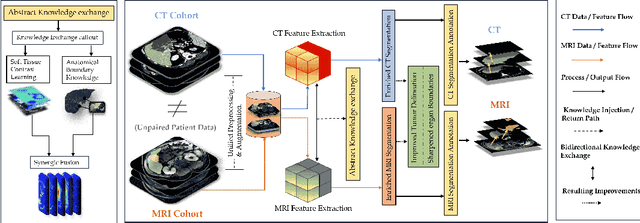
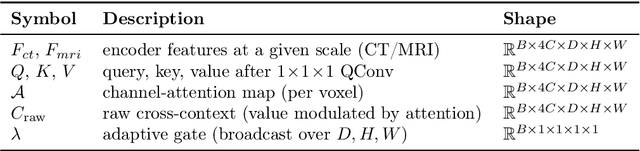
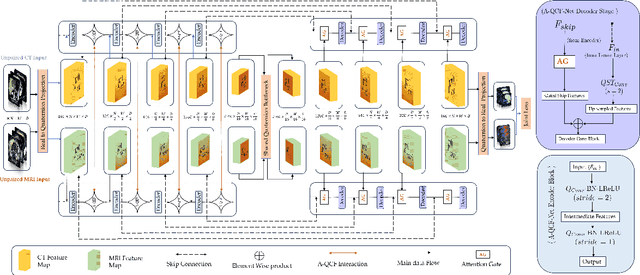
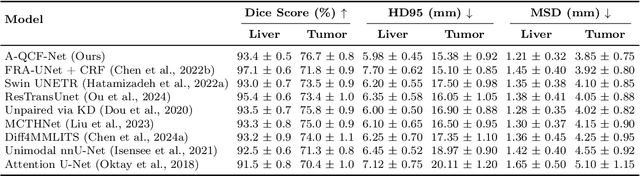
Multimodal medical imaging provides complementary information that is crucial for accurate delineation of pathology, but the development of deep learning models is limited by the scarcity of large datasets in which different modalities are paired and spatially aligned. This paper addresses this fundamental limitation by proposing an Adaptive Quaternion Cross-Fusion Network (A-QCF-Net) that learns a single unified segmentation model from completely separate and unpaired CT and MRI cohorts. The architecture exploits the parameter efficiency and expressive power of Quaternion Neural Networks to construct a shared feature space. At its core is the Adaptive Quaternion Cross-Fusion (A-QCF) block, a data driven attention module that enables bidirectional knowledge transfer between the two streams. By learning to modulate the flow of information dynamically, the A-QCF block allows the network to exchange abstract modality specific expertise, such as the sharp anatomical boundary information available in CT and the subtle soft tissue contrast provided by MRI. This mutual exchange regularizes and enriches the feature representations of both streams. We validate the framework by jointly training a single model on the unpaired LiTS (CT) and ATLAS (MRI) datasets. The jointly trained model achieves Tumor Dice scores of 76.7% on CT and 78.3% on MRI, significantly exceeding the strong unimodal nnU-Net baseline by margins of 5.4% and 4.7% respectively. Furthermore, comprehensive explainability analysis using Grad-CAM and Grad-CAM++ confirms that the model correctly focuses on relevant pathological structures, ensuring the learned representations are clinically meaningful. This provides a robust and clinically viable paradigm for unlocking the large unpaired imaging archives that are common in healthcare.
SSL-MedSAM2: A Semi-supervised Medical Image Segmentation Framework Powered by Few-shot Learning of SAM2
Dec 12, 2025Despite the success of deep learning based models in medical image segmentation, most state-of-the-art (SOTA) methods perform fully-supervised learning, which commonly rely on large scale annotated training datasets. However, medical image annotation is highly time-consuming, hindering its clinical applications. Semi-supervised learning (SSL) has been emerged as an appealing strategy in training with limited annotations, largely reducing the labelling cost. We propose a novel SSL framework SSL-MedSAM2, which contains a training-free few-shot learning branch TFFS-MedSAM2 based on the pretrained large foundation model Segment Anything Model 2 (SAM2) for pseudo label generation, and an iterative fully-supervised learning branch FSL-nnUNet based on nnUNet for pseudo label refinement. The results on MICCAI2025 challenge CARE-LiSeg (Liver Segmentation) demonstrate an outstanding performance of SSL-MedSAM2 among other methods. The average dice scores on the test set in GED4 and T1 MRI are 0.9710 and 0.9648 respectively, and the Hausdorff distances are 20.07 and 21.97 respectively. The code is available via https://github.com/naisops/SSL-MedSAM2/tree/main.
Precise Liver Tumor Segmentation in CT Using a Hybrid Deep Learning-Radiomics Framework
Dec 08, 2025Accurate three-dimensional delineation of liver tumors on contrast-enhanced CT is a prerequisite for treatment planning, navigation and response assessment, yet manual contouring is slow, observer-dependent and difficult to standardise across centres. Automatic segmentation is complicated by low lesion-parenchyma contrast, blurred or incomplete boundaries, heterogeneous enhancement patterns, and confounding structures such as vessels and adjacent organs. We propose a hybrid framework that couples an attention-enhanced cascaded U-Net with handcrafted radiomics and voxel-wise 3D CNN refinement for joint liver and liver-tumor segmentation. First, a 2.5D two-stage network with a densely connected encoder, sub-pixel convolution decoders and multi-scale attention gates produces initial liver and tumor probability maps from short stacks of axial slices. Inter-slice temporal consistency is then enforced by a simple three-slice refinement rule along the cranio-caudal direction, which restores thin and tiny lesions while suppressing isolated noise. Next, 728 radiomic descriptors spanning intensity, texture, shape, boundary and wavelet feature groups are extracted from candidate lesions and reduced to 20 stable, highly informative features via multi-strategy feature selection; a random forest classifier uses these features to reject false-positive regions. Finally, a compact 3D patch-based CNN derived from AlexNet operates in a narrow band around the tumor boundary to perform voxel-level relabelling and contour smoothing.